Are you one of those parents who often find themselves anxiously going over childhood developmental milestones checklists, worried that your child is not meeting all the expected milestones? Have you been worried about a childhood autism diagnosis, developmental delays, or that you just aren’t doing enough? It’s a more common experience than you might think; these kinds of lists can often be a source of considerable stress for parents.
Development is rarely a straight line. Every child’s path is personal and unique, just like every child. It’s normal for different children to develop certain skills on different timelines, depending on factors like environment and early learning. However, it’s important to keep in mind that while every child develops at their own pace, these clinical milestones exist for a reason. They help us distinguish between a child who is taking their time and a child who needs a little extra help to find their voice.
The crucial point to remember about speech and language development is that it isn’t just about talking or learning to read. It’s about making connections. It is about how your child interprets the world and how they tell you about their experiences in it. Let’s look at what is actually happening during these important windows of development.
Birth to 3 Months: Setting The Developmental Foundation
A lot of people think the “newborn phase” is just about survival: diaper changes, sleeping, and eating. But the truth is, it is a period of rapid, complex, and foundational development. Beyond the logistics of meeting basic needs, your baby is intensely absorbing the world: tracking faces, responding to voices, and laying the groundwork for communication through early sounds and cries.
Before they ever say a word, your baby is learning the rhythm of communication.
- Reaction to Sound: You might notice that your baby quiets down if they are crying and hear your voice. It’s their first recognition of safety.
- The Startle Response: Loud sounds should trigger a reaction, usually a startle reflex. This is a key indicator that their hearing and the input for speech are working.
- Vocalizing: It’s not just random noise. They vocalize pleasure (coos, giggles) differently than they vocalize displeasure (cries, fussing). They are already learning cause and effect: I make this sound, and you react.
- Interaction: When you speak to them, they make noise and smile. That is a conversation.
4 to 6 Months: Waking Up to the World
This is where it gets fun. Your baby isn’t just receiving information anymore; they are starting to engage with it.
- Active Listening: At this age, your child should start to look or turn toward new sounds. They aren’t just hearing; they are locating the source and making connections about what different sounds mean.
- Emotional Nuance: They respond to “no” and crucially, they react to changes in your tone of voice. They are learning that how you say something matters as much as what you say.
- The Babbling Begins: Be prepared to hear loops of “ba-ba,” “ooh,” and “aah.” When you talk to them, they want to vocalize back and make noise.
7 to 11 Months: The Misconception Phase
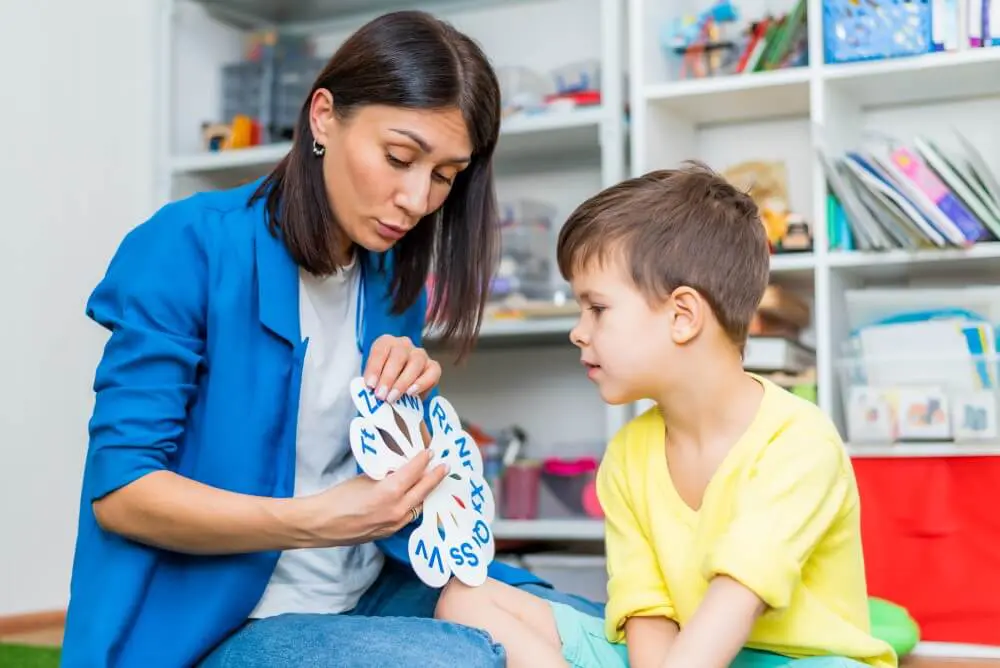
Here is a common trap: Parents often think speech therapy or intervention is only for kids who aren’t talking yet.
But receptive language is building right now, long before the first clear sentence.
- Recognition: During this window, your child usually starts to respond to their own name. They perk up when the telephone rings or someone knocks on the door, they begin to understand what sounds are important and which ones they can ignore.
- Building the Dictionary: They should normally begin learning words for common things like “cup” or “shoe” by this time even if they can’t say them yet. They start responding to requests like “come here.”
- Social Games: They enjoy games like peek-a-boo and actively try to communicate using gestures. Gestures are a huge bridge to language.
12 to 17 Months: The “First Words” Stages
This is usually the “worry zone.” This is when you start comparing your toddler to the toddler at the park who seems to be reciting Shakespeare.
- Labeling: Identifying things by their names is normal at this stage. Your child might start using two to three words to label different people and objects.
- Imperfection is Okay: Their pronunciation may not be clear. That is okay. It counts.
- Following Directions: If you use a gesture, they can follow a one-step command.
18 to 23 Months: The Language Development Explosion
Things normally start to speed up by around 18-23 months. If they don’t, this is often a clear signal to check in with a professional.
- Combinations: We move past single words. They combine words into 2- to 3-word phrases. “More milk.” “Mommy up.” etc.
- Concepts: They understand “not now.” They understand simple “yes-no” questions like “Are you hungry?”
- The Numbers: They should typically use a vocabulary of about 50 words.
2 to 3 Years: Finding Their Voice
Normally, this period is when you start hearing a lot more from your child. They begin to grasp the many different uses of language and are excited about their ability to use it to get what they want.
- Sentence Structure: Sentences get longer, such as three to four words, more complex questions, better understanding of how to communicate their needs.
- Grammar Emerging: You’ll hear plurals (shoes) and past tense verbs (jumped).
- Clarity Check: Pronunciation is improving, but strangers may not be able to understand much of what is said yet. That is normal.
3 to 4 Years: The Social Speaker
Children’s language skills usually begin to really blossom by this age. They understand most of what is said to them, and often surprise and amuse parents and strangers alike with both their grasp of language and their confusion over appropriate and inappropriate language.
- Categorizing: They can group objects. They know foods go with foods and clothes go with clothes.
- Expressing Ideas: It isn’t just about labeling what they see anymore. They express ideas, feelings, and repeat and wonder about things they’ve heard, both good and bad, so proceed with caution.
- Intelligibility: By now, strangers should be able to understand much of what is said. Speech therapy can be a tremendous benefit to children who struggle at this stage.
4 to 5 Years: The Natural Storyteller
By now, your child should have a solid grasp on how to use language. Children at this age usually enjoy speaking with everyone from peers to teachers to strangers in the grocery store. It’s not necessarily a bad sign if your child is less talkative or shy at times, but if they still struggle with basic communication by this age, it’s a clear sign they need additional support.
- The “Why” Phase: Get ready. They answer “why” questions and understand more complex questions.
- Abstract Concepts: They understand tricky spatial concepts like “behind” or “next to”.
- Narrative: They can describe how to do things, such as painting a picture.
Why “Wait and See” is a Dangerous Game for Speech and Language Development
Here is the hard part. When a child misses these speech and language development milestones, a lot of well-meaning people like grandparents, friends, sometimes even pediatricians, will tell you to just wait. “They’ll grow out of it,” they say. Don’t sit back and wait.
Those early years are when your child’s brain is developing the fastest. Every month you wait about your concerns is a month of potential progress you can’t get back.
It is infinitely easier to get a child the support they need when they are two than when they are five and trying to navigate a kindergarten classroom.
Taking action early on can make a significant and measurable difference in the outcome of a child’s developmental stages.
How Scottsdale PBS Can Help Your Children Today
If you’re reading this now because your child is struggling with communicating, we understand how stressed you feel. You are trying to figure out where to start. You are trying to figure out who you can trust. We get it. Our team has worked with families in your exact position. We understand that no two children are alike. That is exactly why we don’t use one-size-fits-all approaches.
We offer ABA therapy, speech therapy, occupational therapy, and diagnostic evaluations all in one place: our beautiful, welcoming 17,000 sq ft facility right here in Scottsdale, Arizona. Our therapists work together to develop treatment plans and therapy programs tailored to each child’s unique needs across multiple domains of development. We communicate every step of the way with parents, families, and other caregivers, so your child gets consistent, integrated support across all their services.
If you are looking at that checklist and feeling a pit in your stomach, don’t wait to make the call. Contact Scottsdale PBS today to schedule a consultation. Let us help your family navigate this journey with confidence!